Product
There are two ways to get architecture wrong, and they pull in opposite directions. Build too much too soon, and you spend months on infrastructure for load that never arrives. Build too little, and you hit a wall that forces a painful, business-stalling rewrite. The teams that get it right aren't smarter, they're just honest about where their product actually is today.
The single most useful question in system design isn't "how would this work at a million users?" It's "what's the next bottleneck we'll actually hit, and how cheaply can we stay ahead of it?"
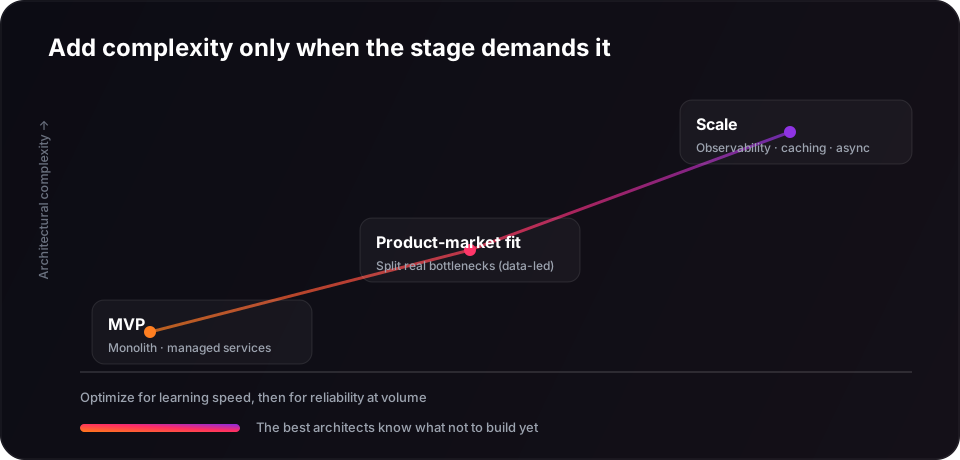
Match complexity to stage
Think of your architecture as having three broad seasons. Each one optimizes for something different, and the mistakes come from running one season's playbook in another.
At MVP: optimize for learning speed
You don't know what you're building yet, you have a hypothesis. The architecture's only job is to let you test it fast and change direction cheaply.
- Start with a modular monolith. One deployable, clear internal boundaries, no distributed-systems tax.
- Lean on managed services, a hosted database, queue, and auth beat anything you'd run yourself at this stage.
- Choose boring technology your team already knows. Novelty is a cost you can't afford while finding fit.
The trap here is "resume-driven development", reaching for microservices, Kubernetes, and event sourcing for an app with fifty users. Every one of those choices buys scale you don't need and pays for it in velocity you do.
At product-market fit: split with data, not vibes
Now you have real usage and real pain. This is where you earn the right to add complexity, but only where the evidence points.
- Measure first. Add tracing and metrics before you refactor. Find the actual hot paths, not the ones you assume.
- Extract services around real seams. If one workload has wildly different scaling or reliability needs, give it its own boundary. Don't split for the sake of splitting.
- Pay down the debt that's slowing you now, not the debt that might matter someday.
At scale: invest where metrics prove need
At real volume, the failure modes are concurrency, cost, and reliability. This is when the heavier tools finally earn their keep.
- Observability becomes non-negotiable, distributed tracing, SLOs, and alerting on what customers feel.
- Caching and read replicas for the queries your metrics show are hot.
- Async processing to move slow, non-critical work off the request path.
A quick reference
| Stage | Default architecture | What to resist |
|---|---|---|
| MVP | Modular monolith, managed services, boring tech | Microservices, premature sharding, custom infra |
| Product-market fit | Targeted service extraction, real observability | Rewrites, splitting everything at once |
| Scale | Caching, async, replicas, strong SLOs | Adding complexity without metrics behind it |
Signals you're over-engineering
- You have more services than engineers.
- A one-line change touches three repos and a deploy pipeline.
- You're debating event sourcing before you have product-market fit.
- Your infrastructure diagram is more impressive than your usage graph.
Signals you're under-engineering
- Incidents are increasing and you can't tell why, because you have no observability.
- A single slow query takes down unrelated features.
- Deploys are scary because there are no tests or rollbacks.
- You're manually doing work that clearly should be a queue or a job.
The best architects are defined as much by what they refuse to build yet as by what they ship.
How we approach it at Appflare
When we take on a build or a modernization, we don't start with a target architecture, we start with the product stage and the next likely bottleneck. We instrument early so decisions are driven by data, keep the design as simple as the stage allows, and leave a clear, documented path to the next season so growth never means a rewrite.
If you're weighing how much architecture your product actually needs right now, talk to us. We'll help you build for where you are, with a credible plan for where you're going.